Never sold. Never shared with advertisers.
No ads, no trackers, no data brokers — in the app or on this site. Even our own usage analytics are structure-only: counts and taps, never your words or your child’s details — and you can switch them off.
Built with families · grounded in research
Spectrelle brings behaviour insight, daily structure, and your own wellbeing into one gentle, private place. Built to understand and accommodate your child, never to “fix” them.
For our son, and every family like ours.
If this sounds familiar
The patterns caregivers describe again and again in the research. Spectrelle is shaped around them.
You mean to note what set off a meltdown — but you’re in the middle of one. By bedtime the detail a clinician needs is gone.
A schedule here, a sleep log there, notes in your phone. Nothing connects — and cost is the most common complaint of all.
Burnout is common among caregivers, yet your wellbeing is the part every other tool forgets.
Appointments, medications, therapy and IEP goals, school notes — held together by memory, on no sleep.
What Spectrelle does
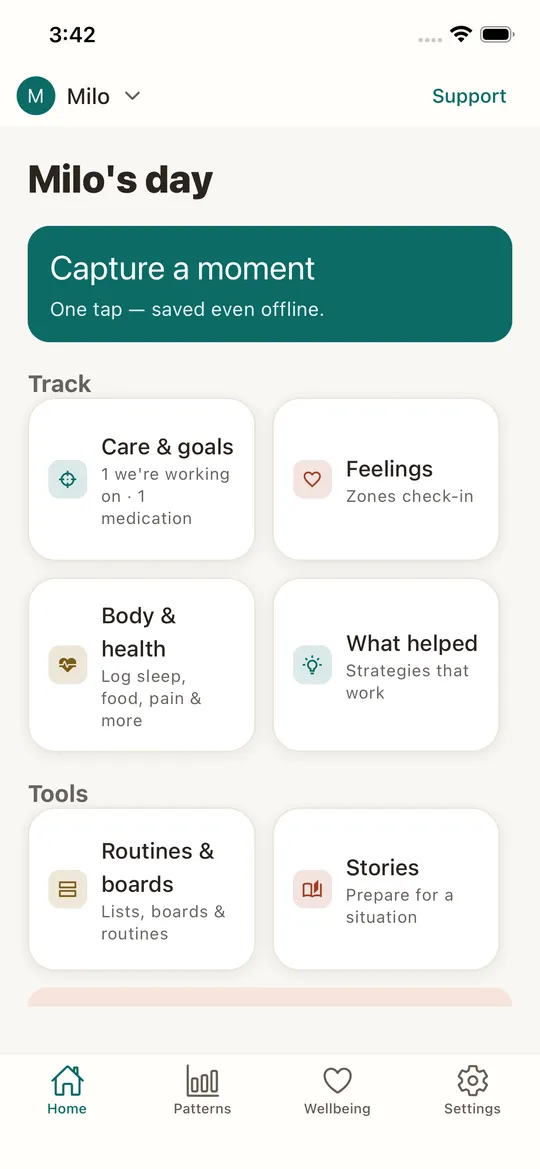
Not another single-purpose app. Spectrelle brings together the pieces caregivers juggle: behaviour, daily structure, your own wellbeing, and the whole support team.
Understand behaviour
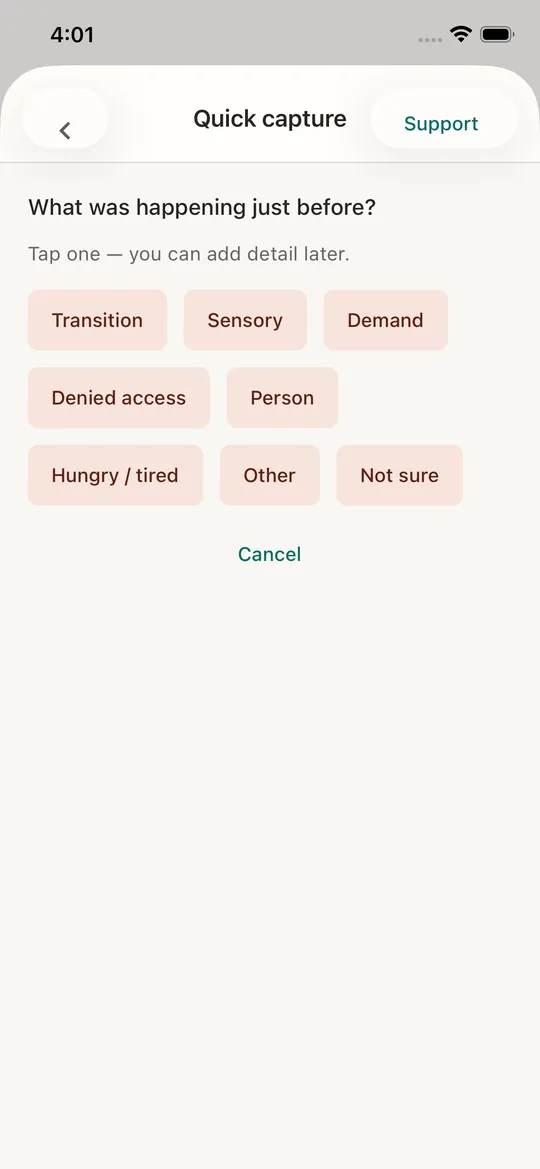
Capture what happened in one tap, even mid-meltdown. It’s the Antecedent-Behaviour-Consequence method clinicians use, in a form you can keep up with — and it’s what the patterns further down are built from.
Spectrelle is a data-collection aid to use alongside your clinician — not a treatment, and not a diagnosis.
Daily structure
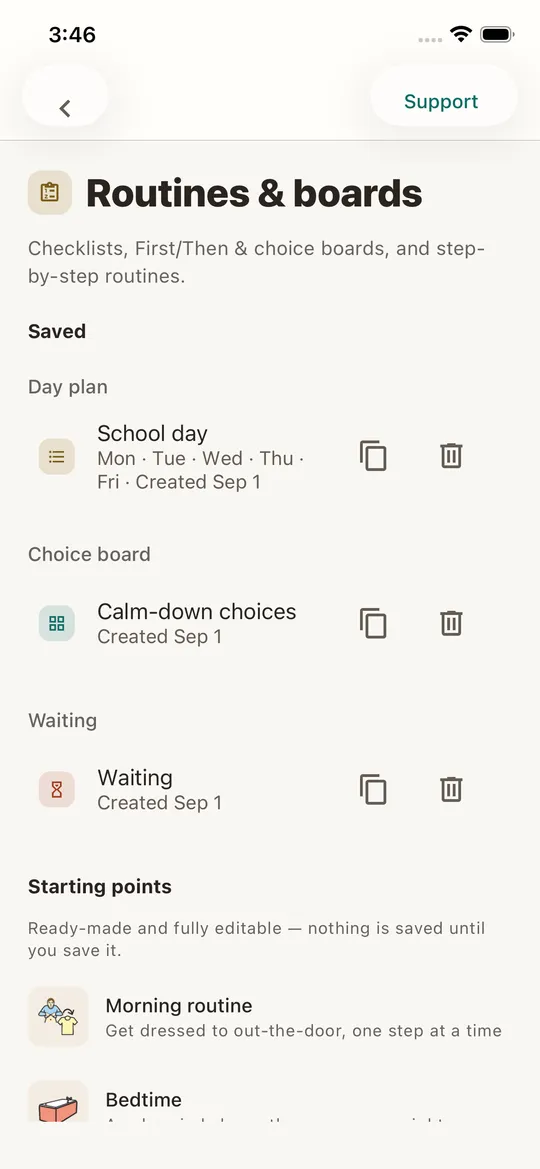
Visual schedules, step-by-step routines, and stories that prepare a child for what’s coming — with the warnings that make transitions easier.
Schedules and stories print, so a support still works when the phone is away — on the fridge, in a school bag, in someone else’s hands.
Your wellbeing
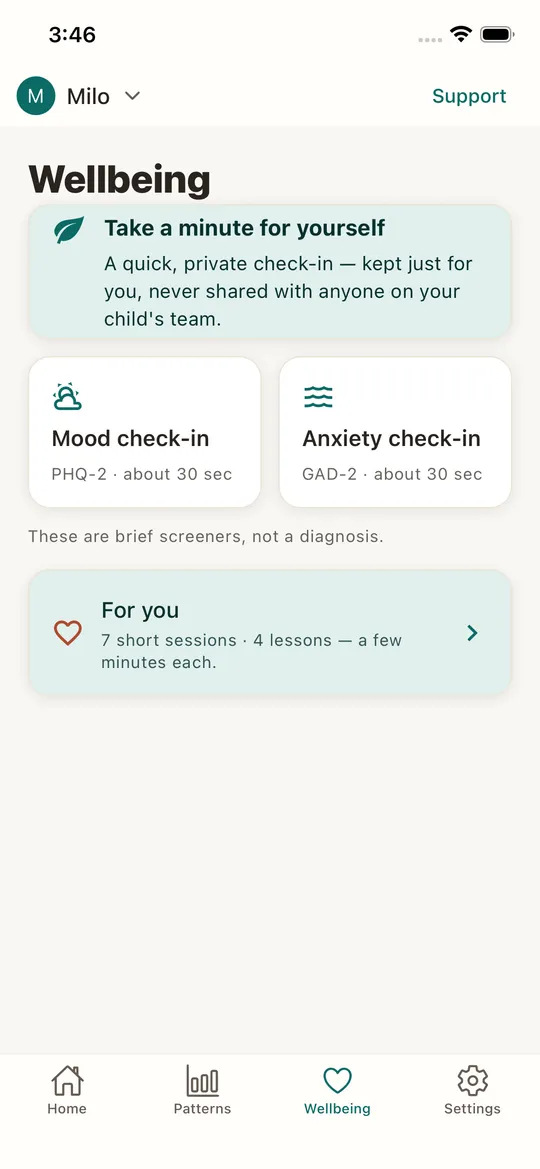
Your wellbeing is part of the picture, not an afterthought — brief check-ins, gentle nudges, and short, evidence-informed support made for caregivers.
Some wellbeing measures (such as the PSI) are licensed instruments, so we’ll only ever use them properly licensed.
Coordinate & connect
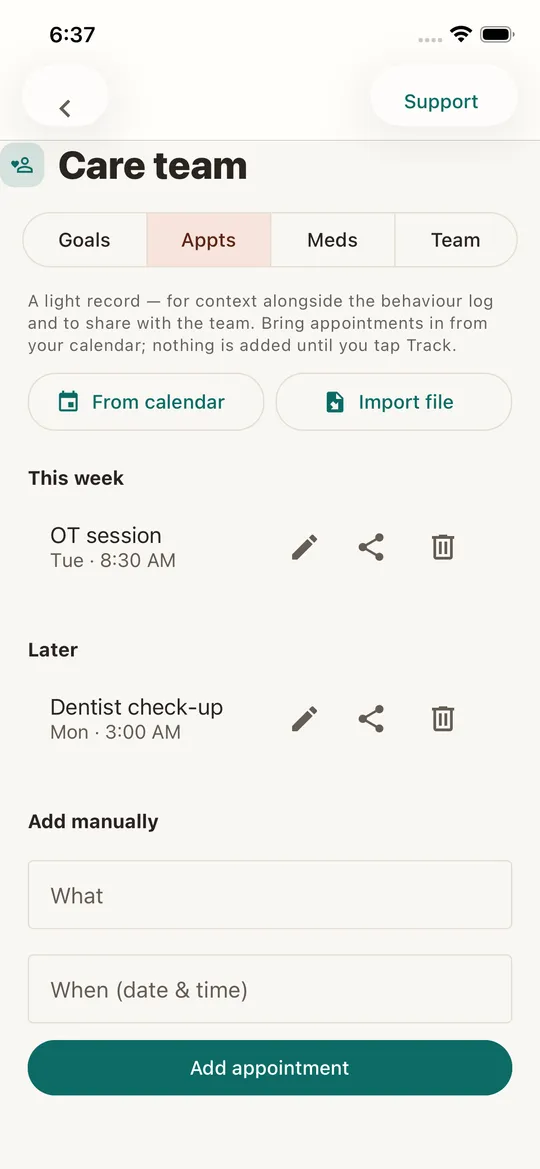
Keep every child, every appointment, and every person who helps in a single shared view.
Spectrelle doesn’t build its own communication device. Instead, it connects with established AAC apps rather than trying to replace them.
Body & health
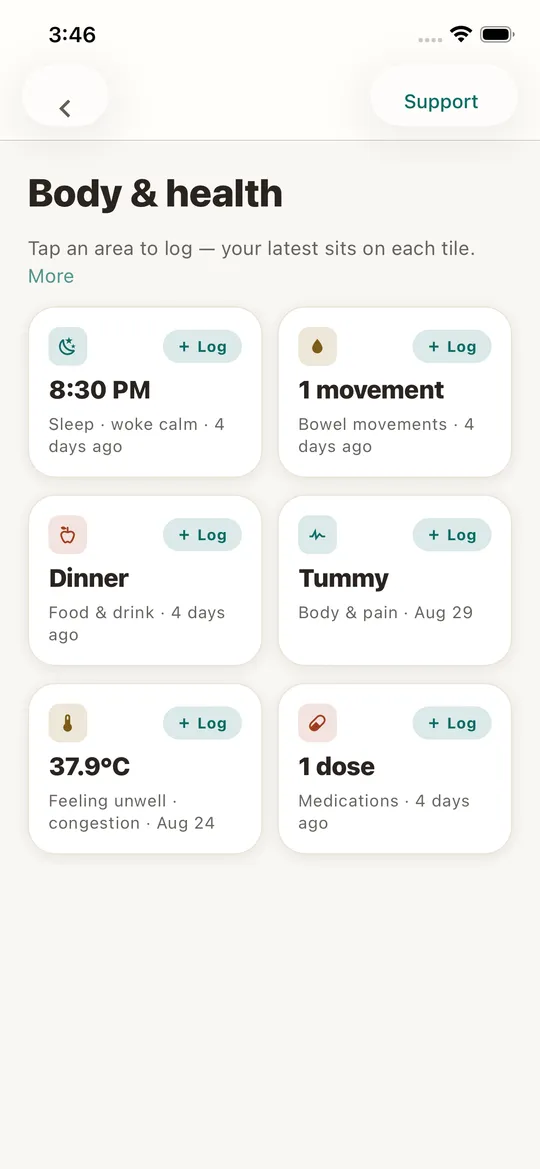
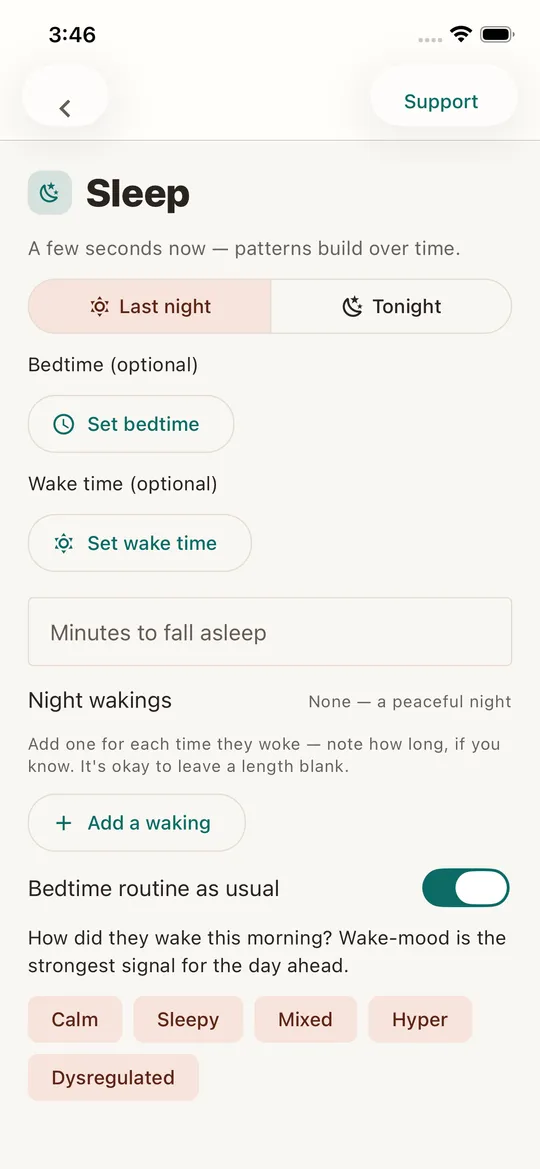
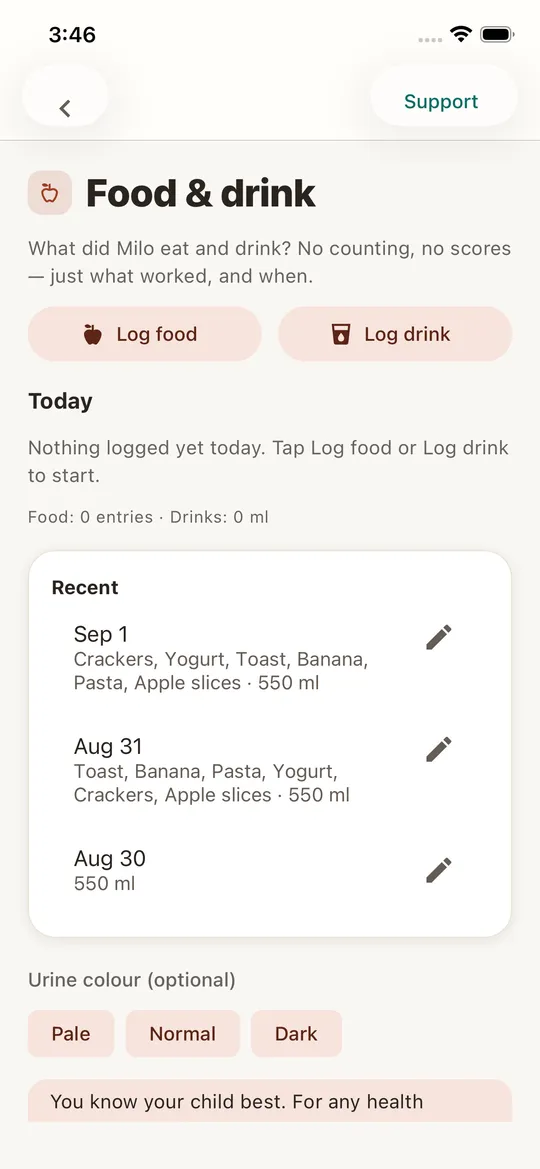
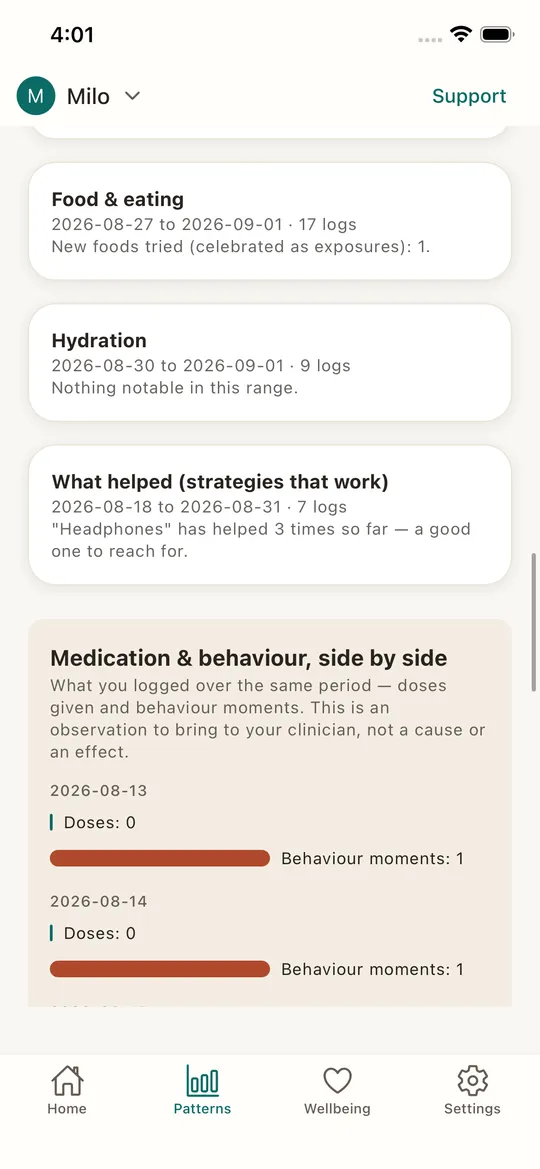
A child who can’t yet say “my tummy hurts” or “I barely slept” still tells you — in the day that follows. Body & health holds sleep, food and drink, bowel movements, comfort, off days and medications in one calm place, so those signals stop being invisible.
These are observations, not tests. Spectrelle doesn’t diagnose, score, or judge — and it never gives dosing advice. Anything medical routes to “discuss with your clinician”.
Patterns & sharing
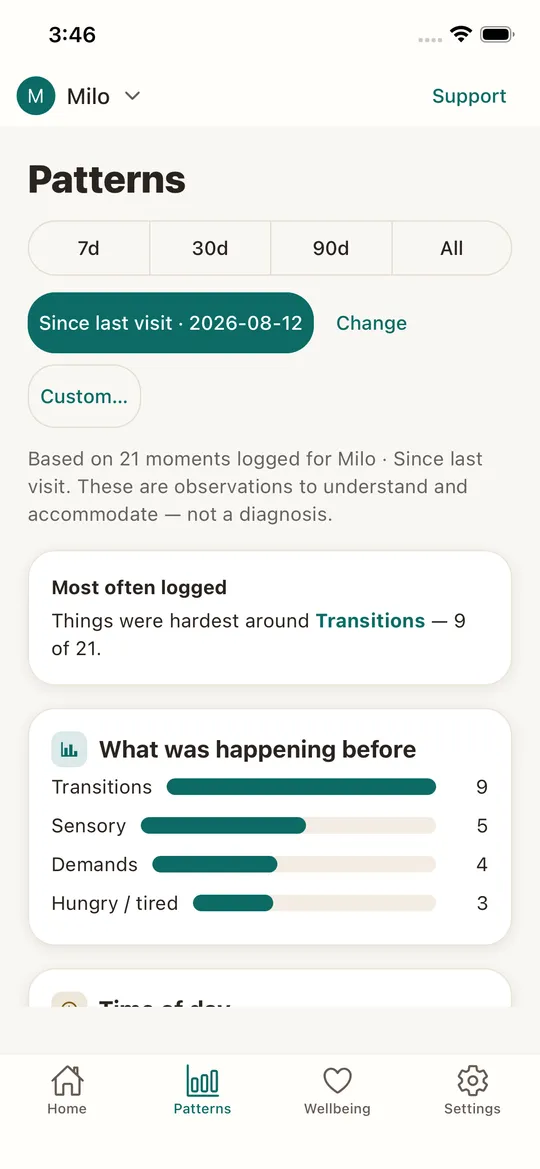
Nobody can hold six weeks of hard mornings in their head, and “it’s been a rough month” is difficult for a clinician to act on. Spectrelle turns what you’ve already captured into something you can look at together — and lets you decide how much of it each person sees.
Choose a window — the last 30 days, or since your last clinic visit — and the moments you captured sort themselves: what was happening just before, the time of day, the setting, and the difference between a meltdown and a tantrum.
Sleep, food, hydration, bowel, pain and illness roll up next to behaviour. Where there’s enough logged to say something, Spectrelle says it plainly — and where there isn’t, it says “nothing notable” rather than inventing a pattern.
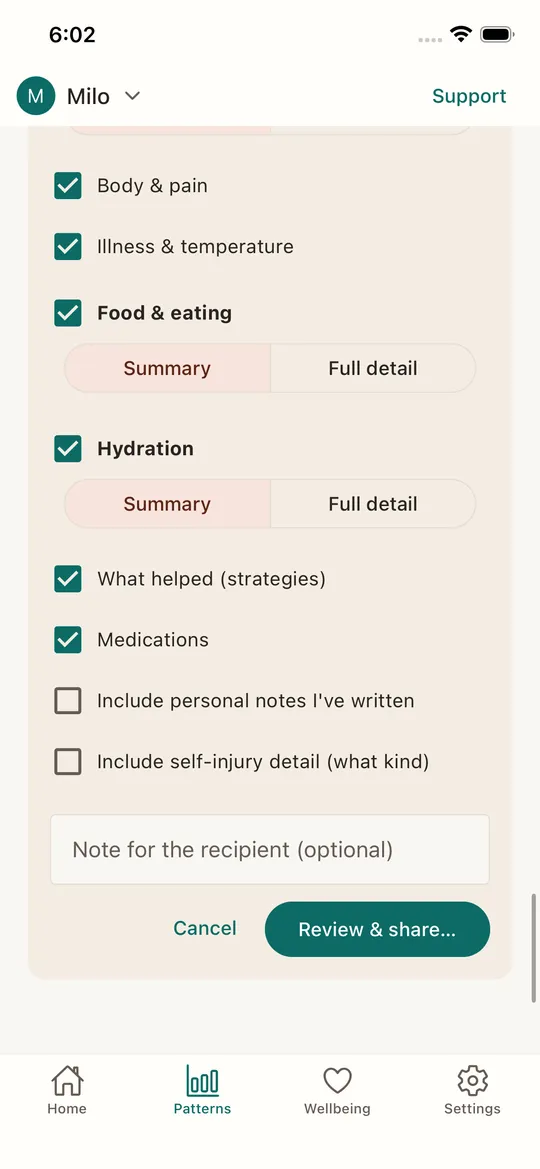
Say who the report is for and Spectrelle scopes it — full food detail for the feeding specialist, behaviour and what-helped for the school, everything for a new specialist. One last screen shows exactly what’s going and what isn’t, before anything leaves your phone.
The report is a PDF you can print, email or hand across a desk. A plain CSV of your raw logs is always available too — on the free tier, without asking us.
Patterns are observations, not conclusions. Spectrelle won’t tell you what a pattern means or what to do about it — it gives you and your child’s clinician the same picture to talk through.
Grounded in research
Spectrelle’s building blocks are named evidence-based practices, mapped to the two US reference reviews of autism intervention. Where the evidence is strong we say so; where it’s thin, we say that too.
A named evidence-based practice — and graded among the highest-quality evidence for easing emotion dysregulation and challenging behaviour.
Knight et al. 2015 · Nuske et al. 2024
The antecedent–behaviour–consequence record underneath Antecedent-Based Intervention and self-monitoring, both recognised practices.
NCAEP 2020
Recognised, but the effects are soft: the largest randomised trial found no group-level benefit on social responsiveness. Genuinely useful for preparing a child for a specific situation — not a social-skills cure.
Wright et al. (ASSSIST2) 2024
Emotion regulation is a well-evidenced target, but the Zones of Regulation framework itself is not an evidence-based practice — so we call it supportive, never “evidence-based”.
Mason et al. 2024
Reference frameworks: Wong et al. (2015) and the National Clearinghouse on Autism Evidence and Practice (Steinbrenner et al., 2020). One caveat we never hide: these practices were validated when delivered by trained practitioners. Spectrelle puts them in a caregiver’s hands — it operationalises the evidence, it isn’t itself a validated clinical treatment, and it’s meant to be used alongside your clinician, never instead of one.
What we stand for
Spectrelle is neurodiversity-affirming. We track behaviour to understand and accommodate — to spot triggers, unmet needs, and what genuinely helps a child feel settled — not to make them “less autistic”. A child’s assent comes before compliance, always; we won’t build anything that rewards masking.
And we’re approach-neutral: Spectrelle works alongside whatever therapy path your family chooses, and alongside your clinician — never in place of one.
Your family’s data
Spectrelle holds some of the most sensitive information a family has. These aren’t policy fine print — they’re product decisions.
No ads, no trackers, no data brokers — in the app or on this site. Even our own usage analytics are structure-only: counts and taps, never your words or your child’s details — and you can switch them off.
Export everything as JSON or CSV, and delete your account and all of its data, in the app, any time — on the free plan too. No emails to write, no retention games.
Access is enforced per-account on our servers — one family can never read, change, or delete another family’s data.
Caregiver wellbeing check-ins are private to you. They never appear in your child’s record, in reports, or in anything you share with the care team.
Reports share only what you choose — pick the topics for each audience, and the report itself says what you left out. Nothing is shared with anyone unless you send it.
We build to COPPA-grade standards for children’s information and HIPAA-aware practices throughout — even though Spectrelle is a wellness support tool, not a medical provider. What you capture offline is encrypted on your device until it syncs.
The long version, in the same plain language: our full privacy promise.
Our story
We’re parents of a wonderful son on the autism spectrum. Spectrelle grew out of our own day-to-day: the small wins, the hard moments, and the long search for tools that understand a child rather than trying to “fix” them.
The name says it plainly: the spectrum. Every autistic child is their own full spectrum of strengths, needs, and ways of being, and every caregiver deserves support that meets them there.
We’re building Spectrelle to help caregivers feel a little less alone, and to give back to the community that has helped us, honestly and with care.
We’re building carefully, with families and the research. Leave your email and we’ll let you know the moment there’s something to try. No spam in between.
Questions
No. Spectrelle helps you understand and manage day-to-day life and share clear information with professionals. It doesn’t diagnose anything and isn’t a substitute for clinical care. Anything medical (like medication) we route to your clinician.
Yes. Spectrelle is a support and tracking tool, not a therapy in itself, so it works alongside whatever approach you and your clinicians choose, whether that’s ABA, speech therapy, occupational therapy, or something else. It helps you capture what’s happening day to day and share clear, useful information with your child’s team.
Your family’s data is sensitive, and it belongs to you. Every account is sealed off on our servers, what you capture offline is encrypted on your device until it syncs, and you can export everything or delete it all at any time — on the free plan too. We’re explicit about what’s stored, how it’s shared, and the consent behind it, and you can withdraw access at any time.
Yes. When you export a report you choose who it’s for and exactly which topics it covers — a feeding specialist can get food and digestion detail while a school copy leaves medical logs out. You can add a note for the recipient, and the report itself states what you chose not to include, so nothing is silently missing. Your own wellbeing check-ins are never part of any child report.
We’re in active development and building deliberately, with families and the research. Join the waitlist and you’ll be among the first to try it.
We haven’t set final pricing yet, but we’ve heard caregivers clearly: cost and real value are the top concerns. We’re committed to fair, transparent pricing and a genuinely low-cost way in.
No. If your child uses a communication app, keep it. Spectrelle connects with and points to established AAC tools rather than trying to replace them.